CNC Turning with Live Tooling
CNC turning for shafts, pins, fittings and threaded parts with live tooling for cross-drilling and milling in one setup, from prototype to small batch.
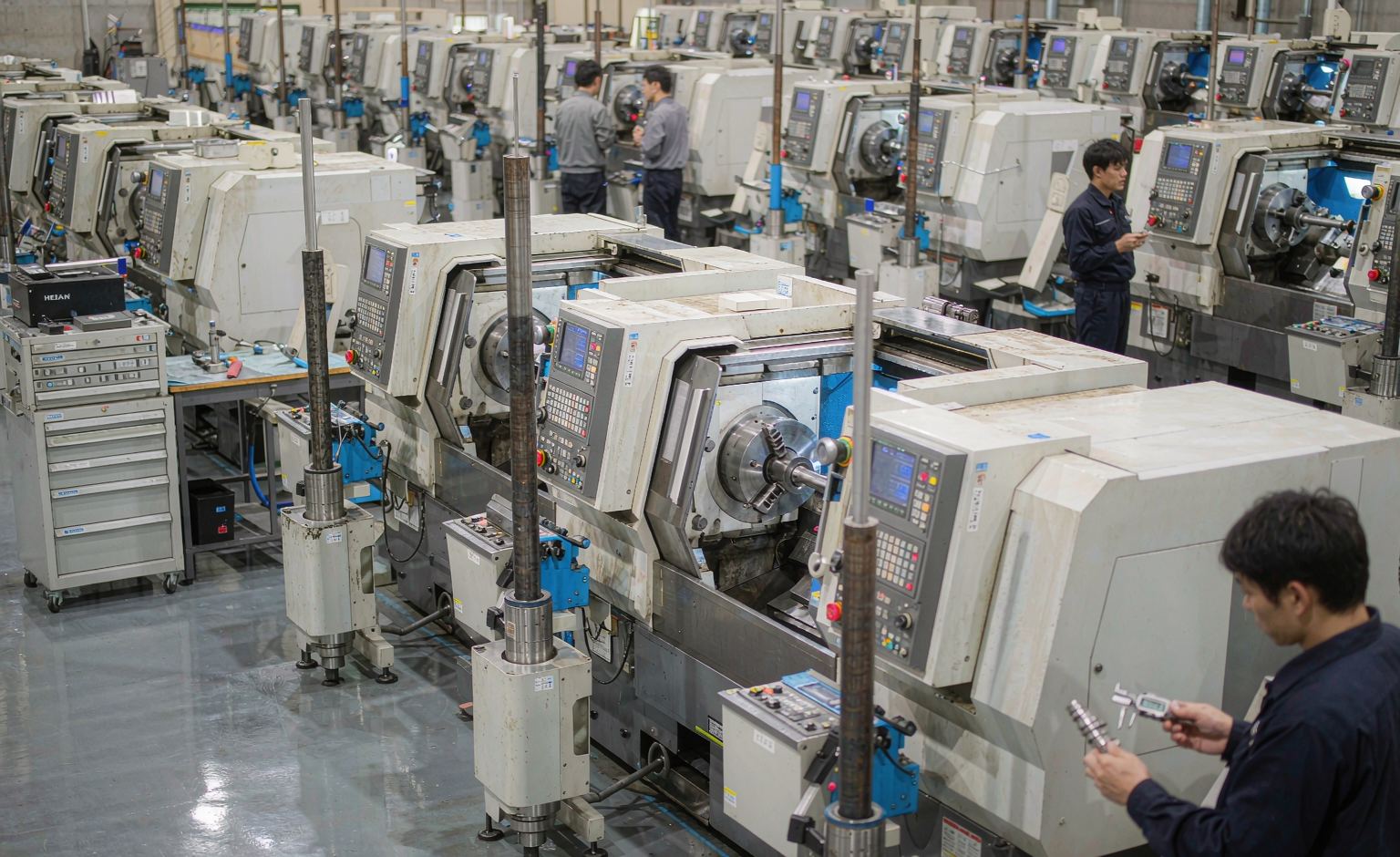
CNC turning produces rotationally symmetric parts by rotating the workpiece against a stationary or driven tool. Xinyuanmu Precision turns shafts, pins, bushings, fittings and threaded parts with live tooling, allowing cross-drilling and milling in the same setup so that diameters and features share a single datum.
When this process applies
Turning suits shafts, pins, bushings, fittings and threaded parts. Parts whose dominant features are flat faces or deep pockets are usually cheaper milled.
Technical specifications
| Typical parts | Shafts, pins, bushings, fittings, threads |
|---|---|
| Tolerance on diameter | ±0.05 mm typical; tighter confirmed by FAI |
| Surface finish | Ra 0.4 µm achievable |
| Live tooling | Cross-drill, slot, axial mill in one setup |
| Threads | Metric, UN, custom per drawing |
Where it is the right choice
- Shafts, pins, spacers and bushings
- Hydraulic and pneumatic fittings
- Threaded inserts and standoffs
- Sensor and connector housings
- High-mix, low-to-mid volume programmes
Where it is the wrong choice
Stating this explicitly matters more than a capability list: if your part falls into one of these categories, another process will cost you less.
- Parts with extensive milling on multiple faces
- Prismatic housings with large internal pockets
- Very high-volume work better served by cold-heading or screw machines
Equipment
- CNC lathes with live tooling
- Bar-fed and chuck workholding
- Thread and gauge verification
Process questions
What does live tooling change?
It allows cross-holes, flats and slots to be cut without a second machine, eliminating one setup and typically two to three days of schedule, while improving accuracy because the milled feature and turned diameter share a single datum.
Can you hold concentricity between two turned features?
Yes, when both are machined in the same setup. If a second operation is required, concentricity depends on the clamping method, and we state the expected band at the DFM review rather than assume it.
Related capabilities and products
Tight-Tolerance Machining
Tight-tolerance machining is the discipline of holding critical dimensions repeatably rather than cutting a small number once. Xinyuanmu Precision machines hardened and specialty alloys such as SUS440C to demanding tolerances by controlling datums, separating roughing from finishing, and verifying every critical feature by first-article inspection..
View capabilityKnowledge Base
Tolerance tables, cost mechanics and DFM rules written for buyers rather than engineers.
Read articlesSend drawings, get a review and a quote
Send a STEP file and a 2D drawing. You get a fixed-price quotation with lead time and a written DFM note — no obligation, and no sales call unless you ask for one.